Pray very Simply

In times of uncertainty, overwhelm or stress, we can turn to the rhythms and rituals of our lives to ground us. Just as seasons of grief, winter or wilderness force us to wrestle with discomfort and uncertainty, so too, these are opportunities to lean into the practices that sustain us and explore new ways of connecting with God that can nurture our soul.

In the liturgical season of Lent, the stretch of time leading to Holy Week and Easter, there is often an emphasis on fasting, a spiritual practice that is intended to make more space for God. You may well choose to give up something for the coming week. Perhaps you will commit to taking on a particular spiritual practice to enrich your connection with God. 

Prayer is one of the primary practices of faith. Modeled by Jesus, the ancient words of the Lord’s Prayer are ones we may have memorized in our elementary Sunday school class. And as with other familiar words, these lines may have become rote, stripped of their meaning and epiphanies. 

Over the next seven weeks, we invite you to reflect on the phrases of the Lord’s Prayer. Regardless of your giving up or taking on, you are invited to consider these familiar words in new ways; to embrace and embody the promises and practices to which these words point. 

May our journey together with the Lord’s Prayer through Lent bring us all some comfort and joy. 

With a God like this loving you, you can pray very simply. Like this:

Our Father in heaven,
Reveal who you are.
Set the world right;
Do what’s best—
    as above, so below.
Keep us alive with three square meals.
Keep us forgiven with you and forgiving others.
Keep us safe from ourselves and the Devil.
You’re in charge!
You can do anything you want!
You’re ablaze in beauty!
    Yes. Yes. Yes.

-Matthew 6:9-13 (The Message)

Invitation to Lent

My children are mostly past the stage of birthday parties with themed invitations.  But I remember receiving many colorful invites in school folders and via email when they were younger. These varied birthday invitations were exuberant calls to spend a couple hours, usually on a Saturday, helping a very loved little one celebrate another year.  While my boys received these invitations jubilantly, as a parent I looked on with trepidation. My Saturday to-do list would now need to be accomplished minus the two hours or more spent at the birthday party.  And littles’ birthday parties can, and usually do, involve lots of screaming kids, too much sugar, and awkward social interactions with other parents.

Invitations, despite the welcoming nature of the idea, are sometimes fraught. An invitation to journey through Lent might feel like receiving a child’s birthday party invite. You will be asked to give something up, and the journey might lead you through places of discomfort and self-reflection. 

But life’s invitations, the good ones, are often like that. There are things to be released and given away but there are also the rewards of new experiences, growth, and resurrection at the end (think birthday cake and sprinkles).

Some Comfort and Joy will be posting every Monday and Thursday during the season of Lent. Sherah-Leigh and I hope you will join us as together we explore the Lenten season and The Lord’s Prayer. 

Counterbalance: Blessing for Renewal

May the wonder of this world renew you day by day.

When you feel distant

isolated and alone

May you be comforted and companioned

by your community 

When you feel overwhelmed

pained and grieved

May you simply be 

through noticing all your body is sensing and experiencing 

When you feel busy

frantic and frenetic

May you simply be

through stillness and silence

When you feel depleted

weary and worn

May you be refreshed and renewed

by the gifts of grounding and connection

May the wonder of this world renew your hope

as you navigate the unfolding of this season. Amen

Counterbalance: The Joy of Transcending Self

“Do nothing from selfish ambition or empty conceit, but in humility regard others as better than yourselves.” –Phillipians 2:3

Accessing our connection to things greater than ourselves can bring us comfort and joy. Whether it is through helping someone else, bearing witness to the grief and pain of another, or investing in actions that bring systemic change, engaging in practices that move us outside of our own pain points and concerns is an important part of nurturing and expressing our faith. 

We often experience the care and work of the Spirit through the companionship and grace of those around us. And we participate in God’s kingdom work when we offer expressions of shalom to those we meet. 

Take a moment today to engage in an activity that honors the value of connecting with something greater than the self. You may choose to take a walk in nature, spend time making a gratitude list or offering a random act of kindness for a friend or stranger. 

Counterbalance: The Comfort of Transcending Self

“Do nothing from selfish ambition or empty conceit, but in humility regard others as better than yourselves.”  –Phillipians 2:3

I can still see myself standing at the island in the church kitchen saying, “And what are you contributing to retreat?” or something equally awful.  I was in my 20’s and working full time at an overwhelming teaching job. At church I was trying to prove my worth by heading up a weekend retreat for our adult Sunday school group. I fumed at those around me as I thought about the papers that wouldn’t get graded and all the food that needed to be packed and prepared for others in the weekend ahead.

When I get annoyed at other people for not pitching in and doing their part, it usually means I have decided to complete more than what I can actually accomplish in one human day. In this unhappy state I am not transcending self, but descending into my own selfish pity party.

Both Suzanne Stabile and Emily P Freeman, Christian spiritual directors and authors, emphasize that asking, “What is mine to do?” is a clarifying question. This is an important question because it tells us two things: (1) Not everything that needs or could be done in the world to help others is mine to do; and (2) There are some things in the world that are mine to do.

Maybe one way to look at self transcendence is a balance of self care and awareness that then leads us to humbly care for others. When we are able to act out of our love for God and with humility, we can access the beauty and growth that comes from helping others.

God, we can see your beautiful creation and the amazing diversity of people in the world. We can also see the many problems in the world. In our own strength we can be quickly overwhelmed.  Help us to learn how to love others selflessly. AMEN

Counterbalance: The Joy of Embodiment

“The Lord God formed the man from the dust of the ground and breathed into his nostrils the breath of life, and the man became a living being.” -Genesis 2:7

Honoring our bodies as a gift can be a countercultural perspective. With the barrage of messaging to be smaller, smoother, stronger, younger or healthier (and the list goes on…) we can easily forget to honor our physical being. Yet our bodies are the way we experience the world. 

Take some time today to engage all of your senses with intention as a way of noticing the gift that your body is. 

You may light your favorite candle, take a warm and fragrant bubble bath or bake your favorite cookie recipe. Enjoy a lingering hug with a loved one, schedule a pedicure or use the fancy lotion you’ve been saving. Walk through your neighborhood listening to the sounds of life, play to your favorite album or sing a hymn from your childhood. Savor a cup of strong coffee, enjoy a square of dark chocolate, or peel an orange. 

As you enjoy each experience, give thanks to God for the goodness that exists with your body as it is in this present moment. 

Counterbalance: The Comfort of Embodiment

God formed Man and Woman* out of dirt from the ground and blew into their* nostrils the breath of life. The Man and Woman* came alive—living souls! -Genesis 2:7 (The Message)

*my own addition

Between the snowy winter weather that drives us indoors (if you live in some parts of North America) and our all too accessible screen times, it can be difficult to live an embodied life this time of year. During February in the Shenandoah Valley, where I live, the night creeps in quickly and leaves slowly in the morning. The cold of January adds itself to this month, making me long for spring. Getting outside to exercise or to perform daily tasks, like getting the mail and feeding my chickens, can feel like a punishment, rather than an opportunity to live an embodied life.

Despite the season, we remain an embodied beings. This just means that for our time here on planet Earth, we move around and experience life in a body.  Depending on the day, our circumstance, and most especially our perspective, that can feel like a gift or a curse!

I am convinced that despite the difficulties I may experience in my human body, my body is a gift from God.  Finding practices that allow us to experience our bodies with joy, improve our relationships with our own spirit, with others, and with God. Our time here in our bodies is finite!  But for as long as we have our bodies, they allow us to enjoy and fully experience the gift of life given to each of us by God. 

Thank you God for this beautiful human body that you have given to me.  May I remember to experience it with joy and thankfulness!

Counterbalance: The Joy of Shared Sacredness

The people were waiting expectantly and were all wondering…” -Luke 3:15

Last fall, several women from my church invited me to a women’s retreat. Four of us shared a hotel room to cut down on cost.  Being all in the nearly 50 something category we shared peri-menopause stories and laughed (and sometimes got a little teary) together about family life. The speaker that weekend was excellent, but memories of being community together are what my heart remembers.

Being in community isn’t necessarily easy. We don’t always agree. People sometimes cause great harm to one another.  However, community can also be a place of great connection and a reminder that we as individuals are not the center of everything.  At its best, church community calls us out of ourselves and into fellowship with other humans. Singing together, sharing our sorrows, and practicing acts of kindness for one another connect us in totally human and hopeful, healing ways.

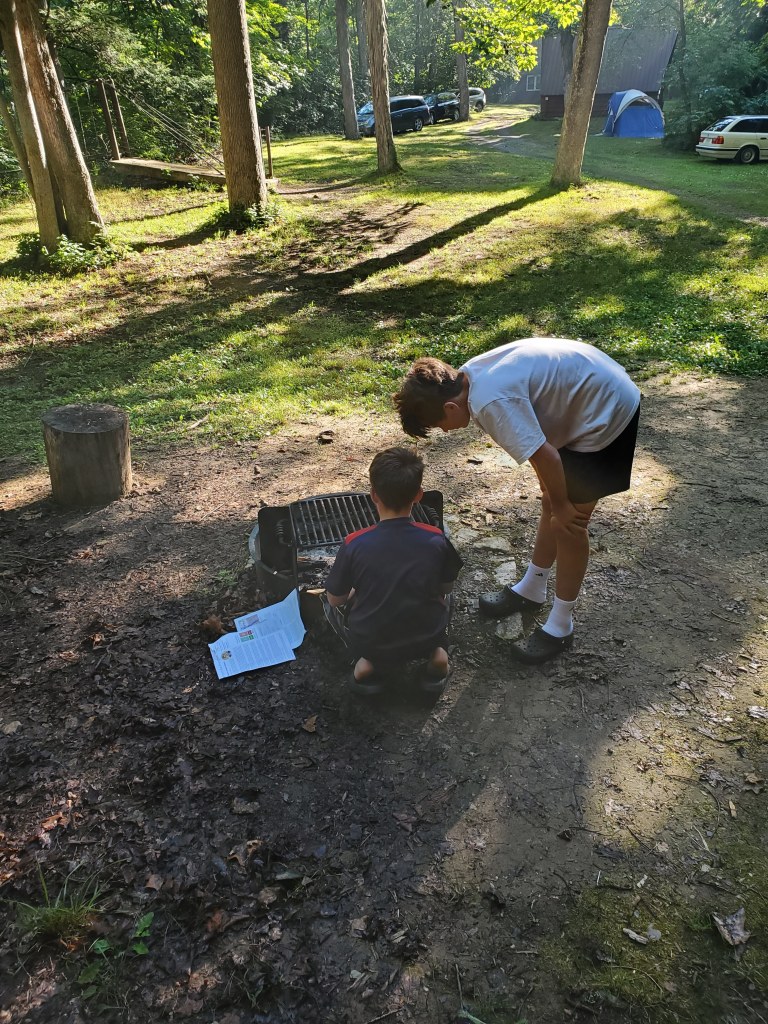
Joel and a friend at church campout.

This week make time to be intentionally present in your church community. Participating in regular church attendance is one way to faithfully practice the spiritual discipline of being community together.

As you have time this week, reflect on these questions:

What does the church community offer or not offer at different ages and stages of life?

In what ways have you consciously chosen to be part of a church community? 

Is your connection different now compared to the past?

In what ways have you benefited from these connections?

When you attend church, does it help you to be more aware of the needs of others?  If so, how?  If not, why?

Counterbalance: The Comfort of Shared Sacredness

The people were waiting expectantly and were all wondering…” -Luke 3:15

Mary set out with haste to a Judean town in the hill country to be with Elizabeth. Their shared blessing and joy is a significant part of the story of the nativity. A shared sacredness between women experiencing something miraculous. Blessed is she

Not much is written about Jesus in the years between his birth and the advent of his ministry,  we pick up the story as Jesus goes to the region of the Jordan to meet with John and to be baptized. A shared sacredness in repentance and forgiveness, baptism and proclamation. Prepare the way of the Lord. 

There is much about our faith experience that is unique, individual and personal. But we are part of a tradition that recognizes the both and. Holy and human. Knowing and mystery. Miracles and longing. Faith and works. Transformation and thorns. Already and not yet. 

Our faith is always a deeply personal experience, but it is never only individual. The life and ministry of Jesus reveal to us the communal nature of our beliefs. We are part of one another. We are called to live and work in community. Shalom comes as we notice the sacred ordinary of this world together. Our joy is multiplied and our griefs divided when we bear witness with one another. 

May your goodness and gifts be revealed to me this day, O God, in and with those with whom I share my life. Amen.   

Up Next…

We are in the days of midwinter. The excitement and energy of a new year– both church year (Advent) and calendar year (January)–is now settling into the routine and ordinary. Soon we will begin our journey through Lent, the season of repentance and fasting that carries us through the ministry of Jesus. 

Often, there’s not much time between Epiphany and Lent. We jump from the birth of Jesus and the arrival of the Magi to Jesus’ temptation and subsequent ministry. However, this year, in the month of February, we invite you to join us as we consider the grounding gifts of faith. 

In his book, The Anxious Generation, author Jonathan Haidt offers specific activities that he believes will help us heal from the unintended consequences of smartphones and social media. Interestingly, the suggested practices he offers to counterbalance the deficits and losses that have come with technological advance are the very same rituals and invitations that the church has offered for centuries. 

In these weeks between Christmas celebrations and the season of Lent, we invite you to join us in recovering the practices of faith and community that nurture and sustain us. Consider the simple, sacred rhythms that connect you with God and others. Receive the refreshment and provision these grounding practices offer in the midst of all that is unfolding.